


Music, just like travel, is hard to separate from Wim Wenders films, for they are intrinsic to his process and his film’s narratives. In Alice in the Cities (1973), the first of his road movie trilogies, a character attends a Chuck Berry concert, while his Cannes winning classic Paris, Texas (1984) would have been incomplete without Ry Cooder’s slide guitar. In Wings of Desire (1987), an angel walks into a Nick Cave concert and Perfect Days (2023) had a perfect rock mixtape as its soundtrack.
So, when the 80-year old German filmmaker, one of the major figures in contemporary world cinema, sat down for an interview with The Hindu in Thiruvananthapuram, the first question inevitably had to be about music.
Rocking the world
“Music was the starting point for me personally when I grew up. All these musicians, be it Bob Dylan, Rolling Stones or Beatles were all of my age and part of this huge rock n’ roll, youth movement. I realised that if they were able to rock the world, maybe I could do that too. There was no film culture in my country in the 1960s Germany. I had the courage and the cockiness to make films because of the music made by the people from my own generation,” says Mr. Wenders. The filmmaker is here as part of ‘King of the Road’, his first India tour and retrospective, organised by the Film Heritage Foundation with the Goethe-Institut.
Mr. Wenders grew up in a Germany that was just recovering from the destruction of Second World War and also the shame of Nazism. His creative pursuits began as a 6 year old, using the “little plastic camera” that his father gifted. This fascination with photography is evident in the wide, static frames in his road movies and in his many protagonists who photograph compulsively. His interests would traverse through painting before settling in films.
“I grew up in a country that did not exist any more, a culture that was ruined and I felt it was up to my generation to completely start from scratch. Starting from scratch is something very healthy and more liberating than if you grew into a tradition. I didn’t like the German culture I was confronted with. I felt it was phony. I liked what I received from American culture, a substitute culture which I was infatuated with for a long time. But then this American dream faded and became almost its opposite. Travel has been an integral part of my life ever since I was a little boy. I couldn’t travel back then, but I wanted to. I realised that the world was much more beautiful than my own town, where everything was in ruins,” says Mr. Wenders.
As one of the pioneers of the New German Cinema, his style leaned more towards documenting than manipulating time. Elements of cinema seeped into his documentaries and vice versa. But, he says, he never had a set filmmaking process.
“The biggest mistake after my first few films was thinking that now I was a filmmaker because I knew how to do it. If you work out of routine or experience, you are not a filmmaker. It is lazy and uncreative. You are only a filmmaker if you know how to react to something and know how to do it as if you haven’t done it before. Every film has to invent how it wants to be made,” he says.
But Mr. Wenders, who hates routines, turned routine into a piece of art, and something that people would aspire to, in his film Perfect Days through the protagonist Hirayama’s routine of photographing sunlight streaming through the leaves and his music-filled drives to work.
“I invented a way that he did his routine work of cleaning public toilets, but filled it with his entire soul. The more I thought about it the more I liked the idea of showing a routine in a way that it becomes more and more interesting. If he does his work like a craftsman everyday from scratch and every day he does it as good as he can and as if it was new, maybe that’s interesting. So that was the beginning of Perfect Days,” says Mr. Wenders.
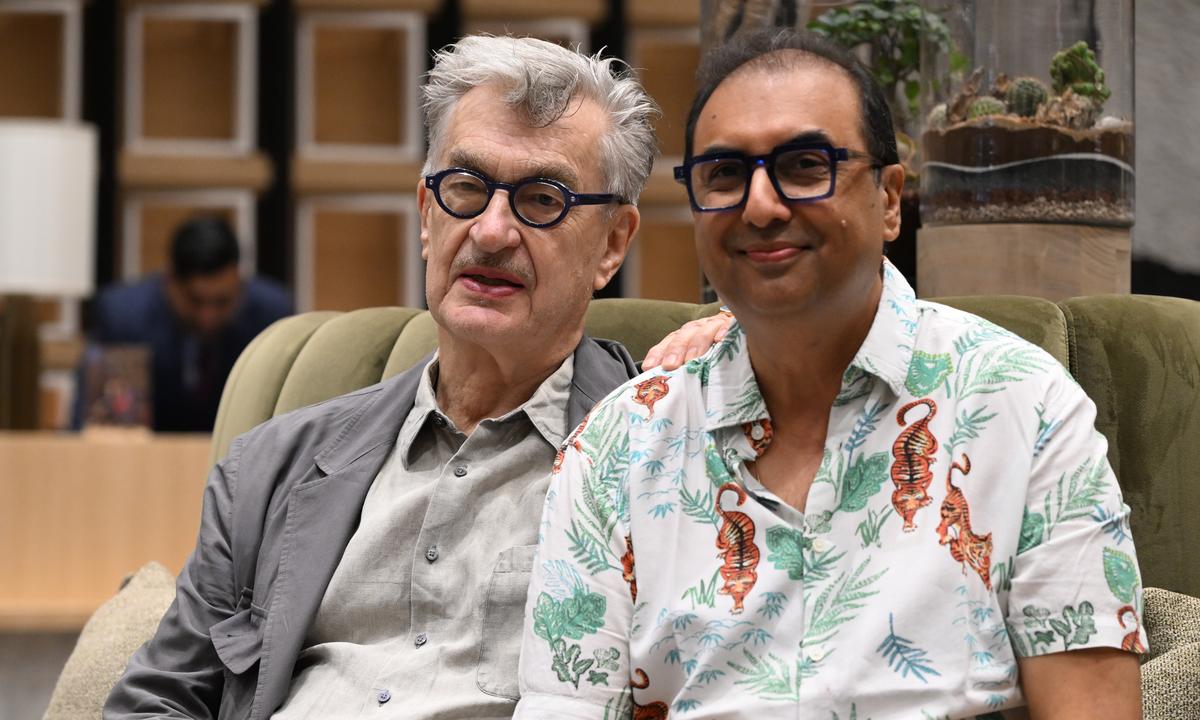
German filmmaker Wim Wenders with Shivendra Singh Dungarpur, founder of Film Heritage Foundation, in Thiruvananthapuram on Monday.
| Photo Credit:
NIRMAL HARINDRAN
A chance meeting with Film Heritage Foundation’s Shivendra Singh Dungarpur in Bologna, the global capital of film restoration, led to his much awaited trip to India.
“I knew the amazing work that Dungarpur was doing. So when he came up with the idea of an India tour, I could not say ‘no’, as India was always like an incredible dream,” he says. But would he make a film set in India, as he has done in so many other countries? “It could very well happen, but you cannot force it. I have started taking photographs and for me taking photographs is a more intense way to be somewhere. Apart from the retrospectives, I have a lot of time of my own everywhere. Let’s see what comes out of it. I already feel a certain attraction and curiosity and I will know better in four weeks,” signs off Mr. Wenders.
Published – February 10, 2025 06:36 pm IST