


Pakistan’s jailed former Prime Minister Imran Khan has told a court-appointed lawyer that authorities at Rawalpindi’s Adiala jail repeatedly ignored his complaints about deteriorating eyesight and that he is now left with only “15% vision” in his right eye.
Click here for the detailed order
Advocate Salman Safdar, appointed as amicus curiae by the Pakistani Supreme Court, visited Mr. Khan at Rawalpindi’s Adiala jail and filed a detailed report about his living conditions and health on February 10.
In the report, seen by The Hindu, Mr. Safdar wrote that he personally observed that Mr. Khan, 73, “appeared visibly perturbed and deeply distressed by the loss of vision and the absence of timely and specialised medical intervention”.
Flagging the “gravity” of Mr. Khan’s condition, Mr. Safdar wrote that it is “imperative that the seriousness of the condition be independently ascertained without delay”. He recommended that Mr. Khan, founder of the Pakistan Tehreek-e-Insaf (PTI) party, “be examined at the earliest by a team of expert ophthalmologists”.
Following Mr. Safdar’s report, the Supreme Court on Thursday (February 12, 2026) ordered Pakistani authorities to set up a medical board to examine Mr. Khan’s eye, and allow him to speak with his children, local media reported.

Mr. Khan, who was arrested in August 2023, was initially kept in the district jail in Attock, and then moved to Adiala in October where he has remained in solitary confinement. During the meeting with the lawyer, the cricketer-turned politician said he experienced “rapid and substantial” loss of vision from October last year, which he repeatedly reported to jail authorities. But his concern was “neither taken seriously nor addressed”, Mr. Khan said.
He added that he “subsequently suffered a sudden and complete loss of vision in his right eye”, following which an ophthalmologist from PIMS hospital, Islamabad, Dr. Muhammad Arif, was called to examine him.
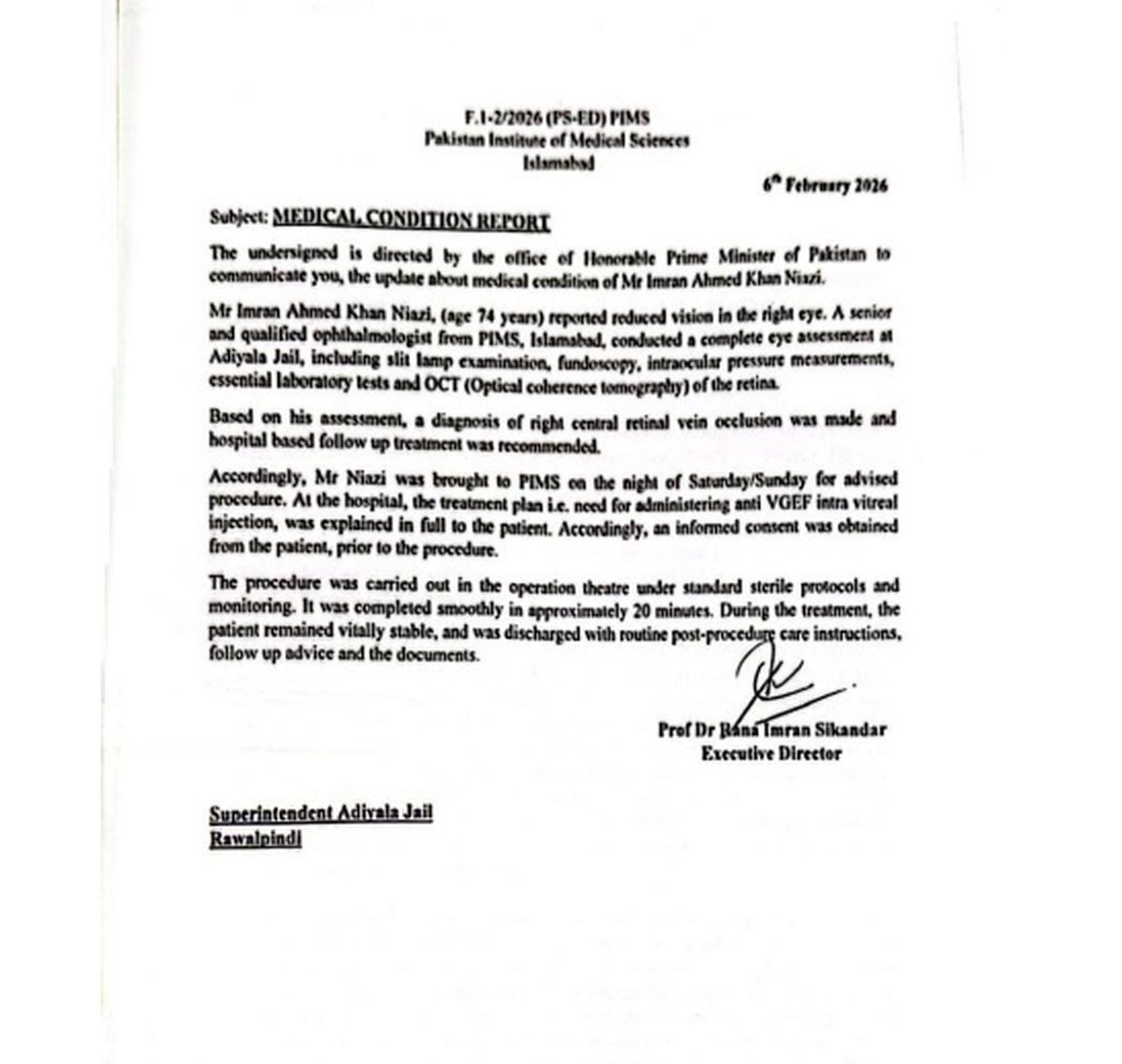
According to a medical condition report prepared by Dr. Rana Imran Sikandar of PIMS, which is also seen by The Hindu, Mr. Khan was diagnosed with “right central retinal vein occlusion” (a clot that blocks the main vein carrying blood away from the retina, a serious condition which causes sudden or gradual vision loss). Earlier this month, he was administered an “anti-VEGF intravitreal injection” (which injects medication directly into the eye’s vitreous gel) in an operation theatre, stated the report.
“Despite the treatment administered, including an injection”, Mr. Khan told the amicus curiae, he has been left with only 15% vision in his right eye. “Throughout the interview, his eyes were watery, and he repeatedly used a tissue to wipe them, reflecting physical discomfort,” wrote Mr. Safdar in his report.

Last week, jail authorities had said that Mr. Khan was briefly taken from prison to a hospital in Islamabad for an eye procedure, sparking concerns among his family and supporters. The PTI complained that they were not informed in advance and alleged that the former Prime Minister was being denied proper medical care. Then the Supreme Court appointed Mr. Safdar as a “friend of the court” to visit Mr. Khan and file a report.
The PTI, Mr. Khan’s party, welcomed the Supreme Court decision to appoint a medical board to examine him. “The Supreme Court’s order for a complete eye check-up of Imran Khan vindicates the party’s longstanding concerns about his deteriorating health and denial of timely, independent medical care in custody,” the party said in a statement.