


Rabindranath Tagore, the iconic poet, artist and Nobel laureate, has a connection with the India Meteorological Department (IMD), the Government’s primary agency for weather forecasting and climate services.
His wife and he would sit under a tree at IMD Calcutta, where it was headquartered when set up by the British in 1875. This little-known story is one of the many highlights of the ‘open art museum’ at the Mausam Bhawan on Lodhi Road.
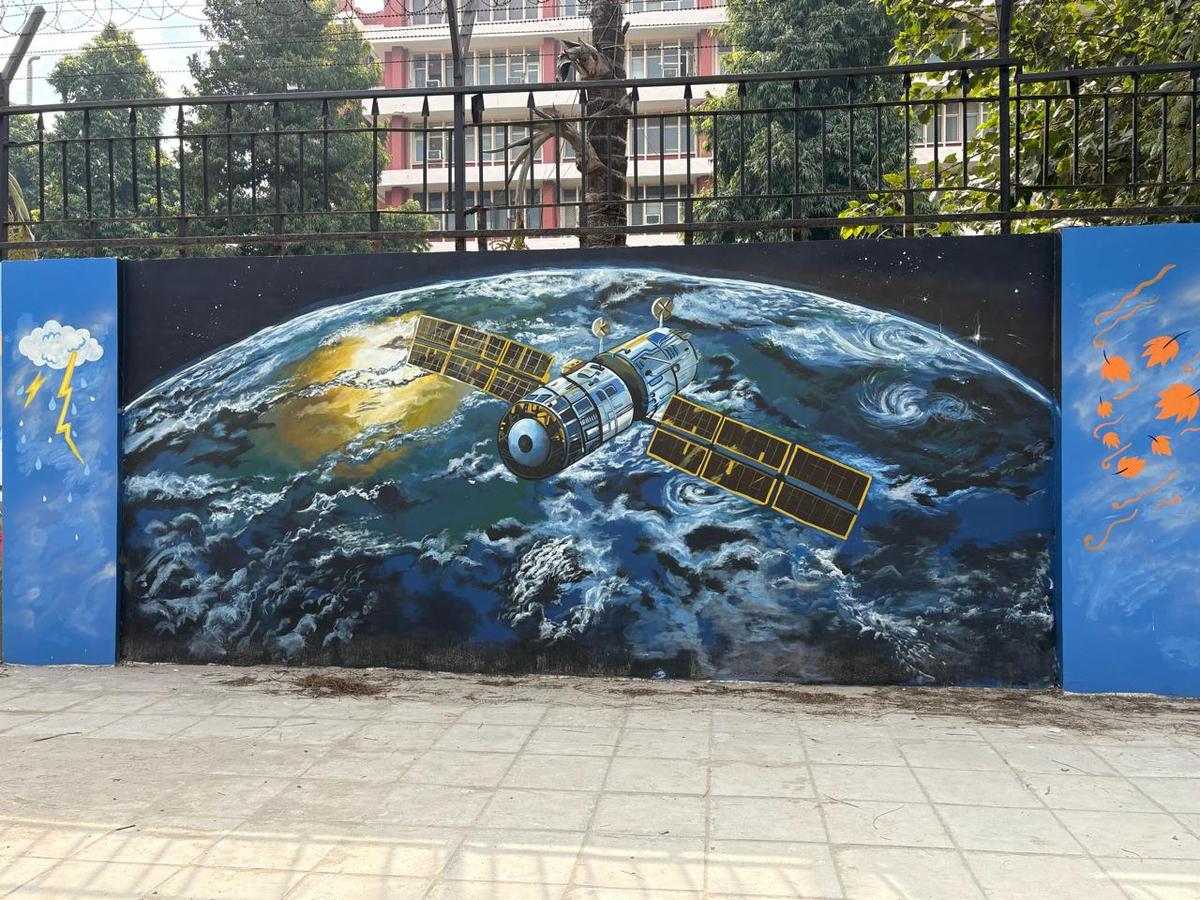
In its sesquicentennial year, IMD invited Delhi Street Art (DSA) to create 38 murals on its building. Some of the murals are as large as 20 feet X 8 feet. The work commissioned by the Ministry of Earth Sciences, kept 40 artists engaged for four weeks to weave a narrative around weather as in mythology, its celebration, the history of IMD and the technology used now for weather predictions.
There are references to Chanakya, the astute politician who is believed to have used statistics to predict weather; Kalidas, for his epic poem Meghdoota in which ‘monsoon’ is the key element and; Tansen, who could summon the rain with his voice.
Murals done by Delhi Street Art on Mausam Bhavan on Lodhi Road.
| Photo Credit:
SPECIAL ARRANGEMENT
The artists have also put the spotlight on IMD’s technology that accurately predicts weather patterns and issues timely alerts in support of farmers and fisherfolk. The panels show an official alerting fisherfolk to an upcoming cyclone, a satellite and farmers holding phones. “The satellite has become a popular spot for selfies,” says Mayuri Saini, director, DSA. “We have also created a list of dos and don’ts to be followed during a weather exigency like heatwaves or cyclones,” she adds.
The exercise was not just an opportunity to celebrate 150 years of IMD but also pay homage to Yogesh Saini, an engineer, who shifted to Delhi from the US with a vision to beautify the city’s surroundings and enable people to connect with it. He founded the DSA 13 years ago and painted the garbage bins in Lodhi Garden as his first project. Yogesh passed away last year and Mayuri feels the DSA has come full circle.
The evocative imagery on the walls of Mausam Bhavan is appealing with the cherry blossoms blooming in Shillong, people heading off to mountains in jeeps, scenes from the rainiest place in India — Mawsynram in Meghalaya — and three people wearing husk raincoats in the place, and the depiction of a hailstorm in Himachal Pradesh that once affected apple orchards in the State. The information conveys a variety of themes.
DSA has created several public art works across the city in the inner circle of Connaught Place, Moolchand Flyover, Shankar Market, multiple schools and a series ahead of the G20 Summit last September.
“Many of these murals are gone given the transient nature of street art. It cannot go on for 100 years, subject to Nature’s vagaries, seepage etc. One has to simultaneously keep creating and sharing new art,” says Mayuri, who with her group of artists will be redoing the Shankar Market mural soon.
Published – March 20, 2025 11:12 pm IST